Repairing Concrete Cracks Before an Epoxy Floor
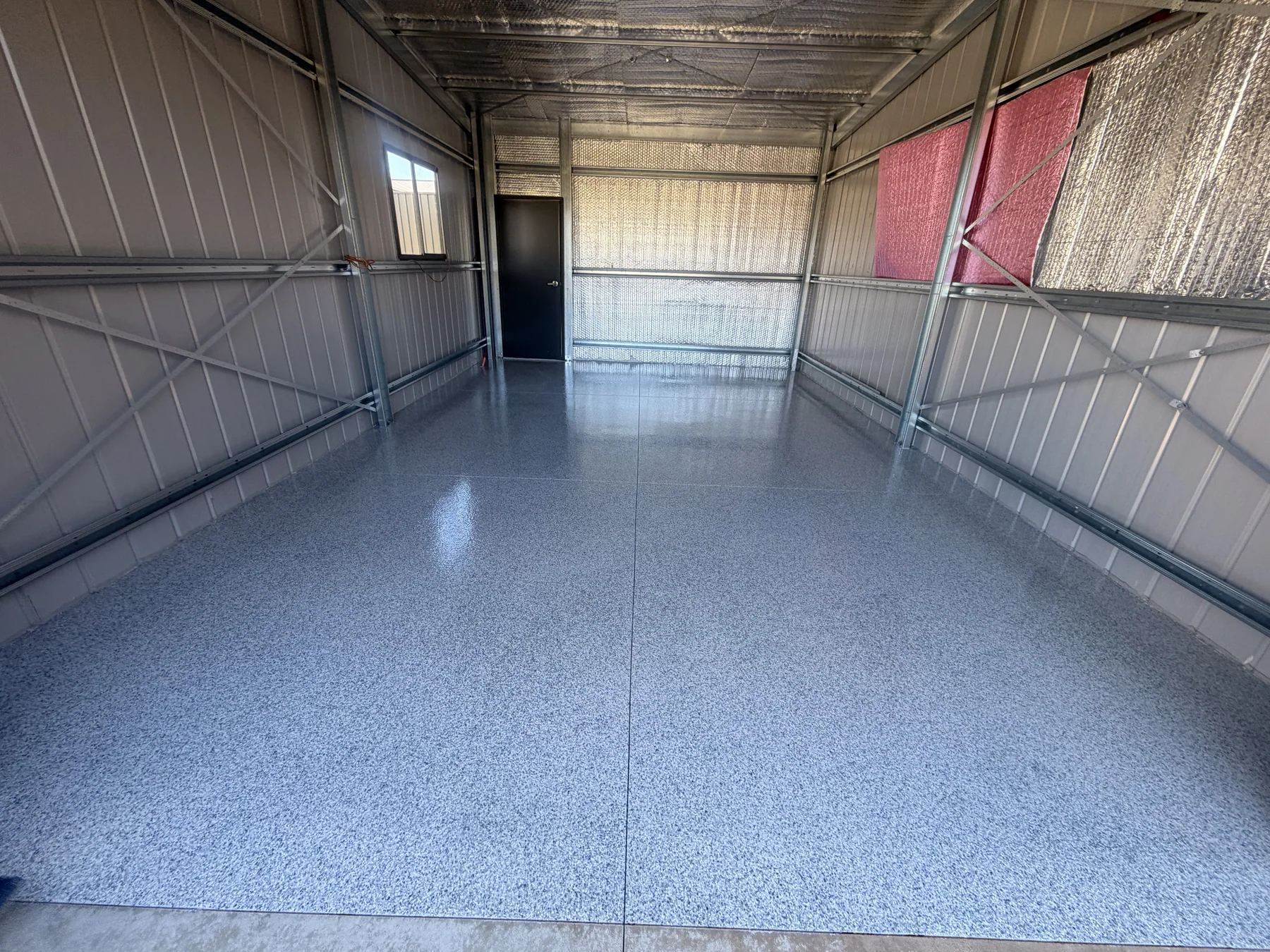
Most older Melbourne slabs have some cracking. Hairline shrinkage lines, a split near the doorway, or a joint that has opened up over time are all common in garages, sheds and commercial floors. An epoxy coating can go over a repaired slab, but it cannot hold a moving crack together on its own.
This guide explains which cracks we fill as part of an epoxy installation, what filling cannot do, and why some joints are left to keep working. The details are always confirmed at a free site visit.
Why cracks matter under a coating
Epoxy forms a continuous film. If the concrete on either side of a crack is still moving, that movement can telegraph through the new floor as a line, or, in more serious cases, stress the coating. Filling a stable, non-structural crack before the primer goes down gives the system a sounder surface and a cleaner finish. Leaving a live joint or a structural defect hidden under a decorative coat simply delays the same line showing up again.
That is why crack assessment sits with moisture testing and grinding, not as a cosmetic afterthought. Our garage flooring mistakes guide flags skipped repairs as a common problem. The Concrete Institute of Australia is a useful independent reference on how concrete shrinks, cracks and moves as it dries and as loads change.
The cracks we usually see in garages and sheds
Not every line in the slab is the same:
- Hairline shrinkage cracks are very common in residential garages. Many of these are stable and can be cleaned out and filled as part of preparation.
- Wider cracks, broken edges or areas where the slab has stepped may need more substantial patching before a coating is specified.
- Isolation and expansion joints are designed to move. They are not treated as defects to be erased. In most cases those joints remain, and the coating is detailed around them rather than used to glue the slab together.
- Cracks that keep opening, that are associated with settlement, or that point to a structural issue, are outside the scope of a standard epoxy preparation. In those cases we will tell you what we can coat and what needs a concrete or structural assessment first.
If the floor is also out of level, flattening is a separate decision. See self-levelling epoxy for uneven concrete. A levelling compound does not replace crack diagnosis.
How repairs fit into preparation
We diamond grind the slab. We do not acid etch. Grinding opens the surface, reveals the true width of fine cracks, and gives fillers and primers something to bond to. Unsound edges are removed, cracks are cleaned, and a repair product suited to the movement (or lack of movement) in that location is applied before the primer coat.
The exact products and joint details are written into the quote after we see the slab. All Purpose Coatings publishes information on the coating systems that go over a prepared substrate. The repair work underneath is specified for the crack in front of us, not copied from a generic list.
Old paint, oil staining and moisture can sit alongside cracks on the same garage floor. Those issues are assessed together. See diamond grinding versus acid etching, epoxy over oil-stained concrete and moisture testing.
What a filled crack will look like later
A well repaired, stable crack should be much less obvious under a flake floor, because the blend breaks up the surface visually. Ultra Flake is Floor Lab's standard flake range, and Hyper Flake is the premium flake range. Metallic finishes can also disguise a repaired line, provided the substrate is sound. A smooth, solid colour will show residual lines more readily than flake.
No finish can promise that a moving joint will stay invisible forever. If a joint needs to keep working, we will explain how it will be detailed, rather than coating over it and hoping it disappears.
Time on site, cure and price
Crack repair is one of the reasons the time on site varies. Most standard residential garages take 1 to 2 days, depending on the slab condition and any crack repair. Metallic garage floors take 3 to 4 days. We confirm the timeline at your free site visit. A slab with only fine shrinkage lines is a different job from one that needs extensive patching.
Light foot traffic is usually safe after 24 to 48 hours, with instructions for your job. Cars can typically be parked after 5 to 7 days. Waiting the full 7 days is the cautious approach. Heavy vehicles should wait 7 to 14 days. See the FAQ for those stages.
A single garage starts from $2,000 and a double garage from $2,800, with metallic garages from $6,000 and larger areas from $50 per square metre. Those starting figures include diamond grinding and a 7-year workmanship warranty. Where crack repair is more than a routine fill, it is reflected in the written quote, typically sent within 24 hours of the visit. The warranty covers delamination, peeling and coating failure caused by the installation process. It does not cover later movement in the concrete itself, physical impact, improper maintenance, or use before the curing period has passed.
Frequently asked questions
Can you epoxy over a cracked concrete floor?
In many cases, yes, after the cracks have been assessed and repaired where appropriate. Stable shrinkage cracks are commonly filled as part of preparation. Moving joints and structural defects need a different approach, which we explain at the site visit.
Will the cracks show through the new epoxy?
A flake finish will usually hide repaired, stable cracks better than a smooth solid colour. Live joints may still read as a straight line, which is why they are often left to work rather than being filled as if they were a defect.
Is crack filling the same as fixing a sinking slab?
No. Epoxy preparation can repair the surface of a sound slab. It is not a structural underpinning or slab-jacking service. If we see signs of settlement, we will say so before any coating is specified.
How do I get a quote that includes crack repair?
Request your in-person quote or call 0468 159 615. We inspect the slab, include the necessary repairs in the scope, and typically send a written quote within 24 hours of the visit.
Get an in-person quote
If your garage or shed slab is cracked and you are considering epoxy, the useful next step is to have those lines inspected in person. Request your in-person quote, or call 0468 159 615, and a Floor Lab specialist will assess the concrete, explain what can be filled, and send a written scope. Browse finished floors in the gallery or start with garage epoxy flooring.